Quantum Computing for Everyone
First Edition · 2026

A quantum computing textbook you can touch

393 pages that build every idea from zero — and a free Android app with 36 interactive labs, where every number on screen is worked out by the app's own quantum simulator while you watch.

Free. No ads, no accounts, no permissions. Works with no connection.
|0⟩ |1⟩
How it works

Read it, play with it, then prove you know it

The book and the app are the same course. Every chapter has a lab, and every lab is built on the mathematics that chapter just taught you.

01 — LEARN

Plain English first

Every idea is explained in short sentences and common words before a single symbol appears. Complex numbers, vectors and probability are taught from zero in three appendices, so school algebra is enough to begin.

02 — PLAY

36 interactive labs

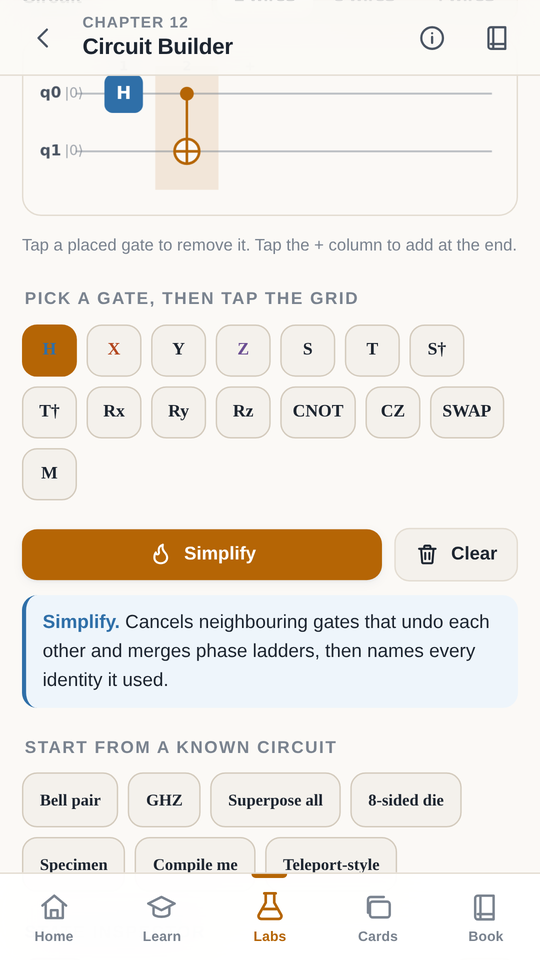
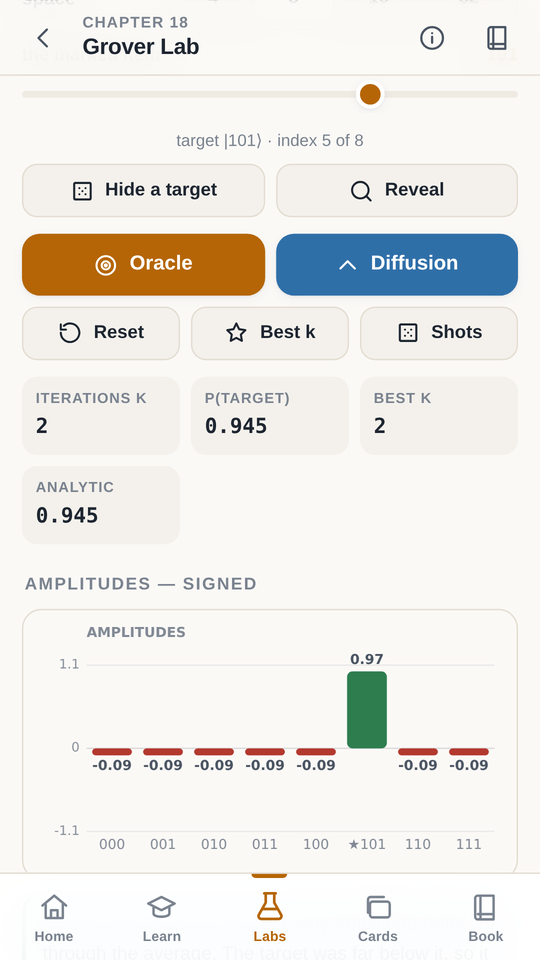
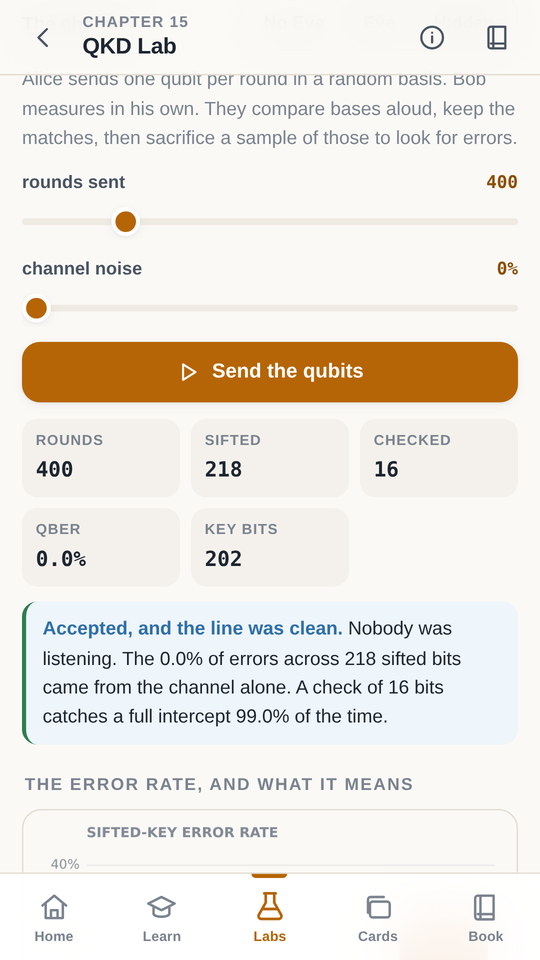
Drag a qubit around the Bloch sphere. Build a circuit gate by gate. Watch Grover's search grow the right answer, then push it too far and watch it shrink. Catch an eavesdropper from the error rate on a quantum key.

03 — PRACTICE

647 problems, all solved

Three levels of practice at the end of every chapter, plus quizzes with explanations and flashcards that come back just before you would forget them. A separate Teacher's Guide solves every problem step by step.

The app

Nothing here is a video. It is all live.

The app carries its own quantum simulator — state vectors, gates, measurement, noise. When a lab says the success probability is 94.5%, it worked that out from the amplitudes a moment ago. Nothing is pre-recorded and nothing is faked.
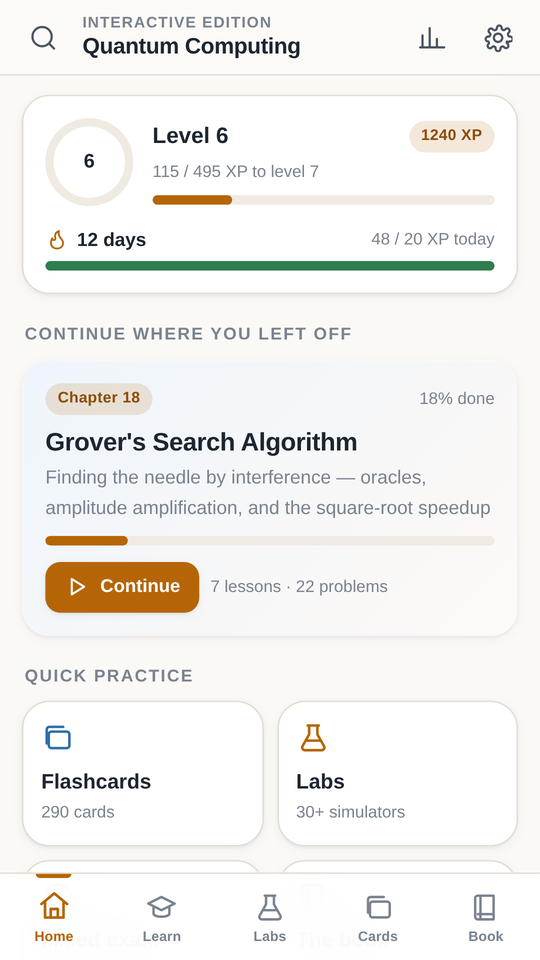
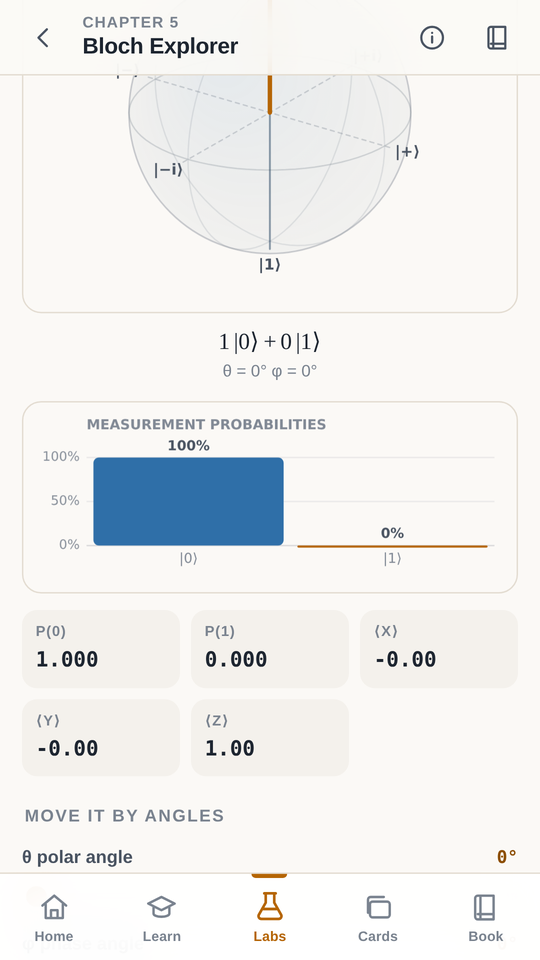
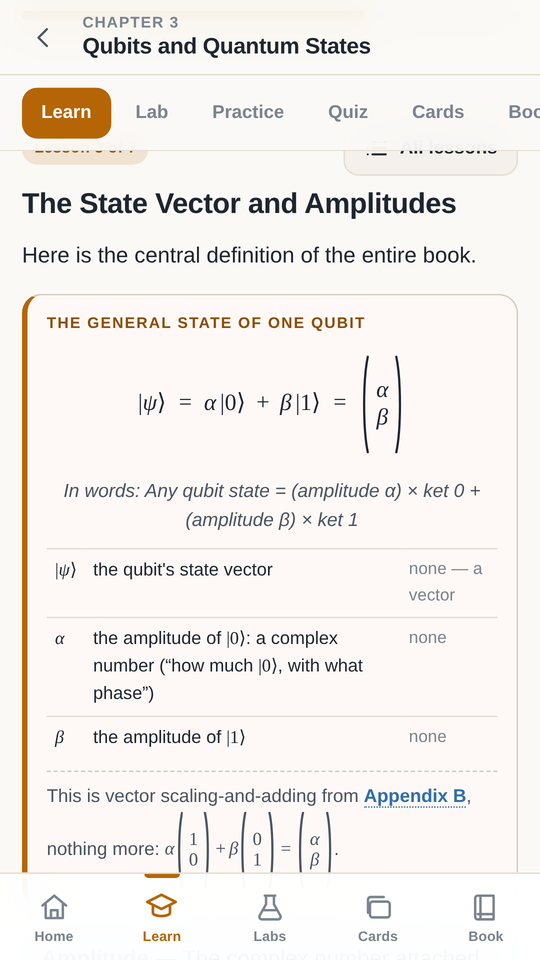
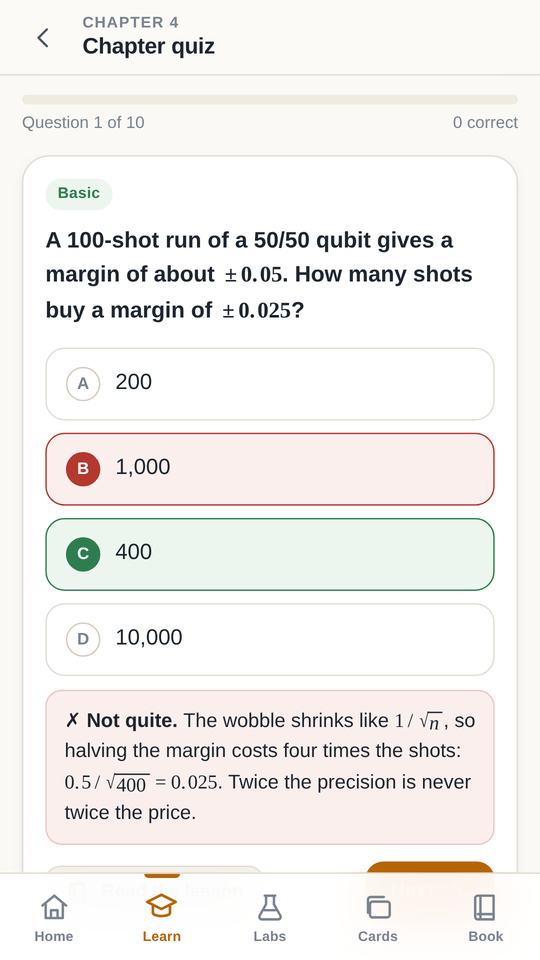
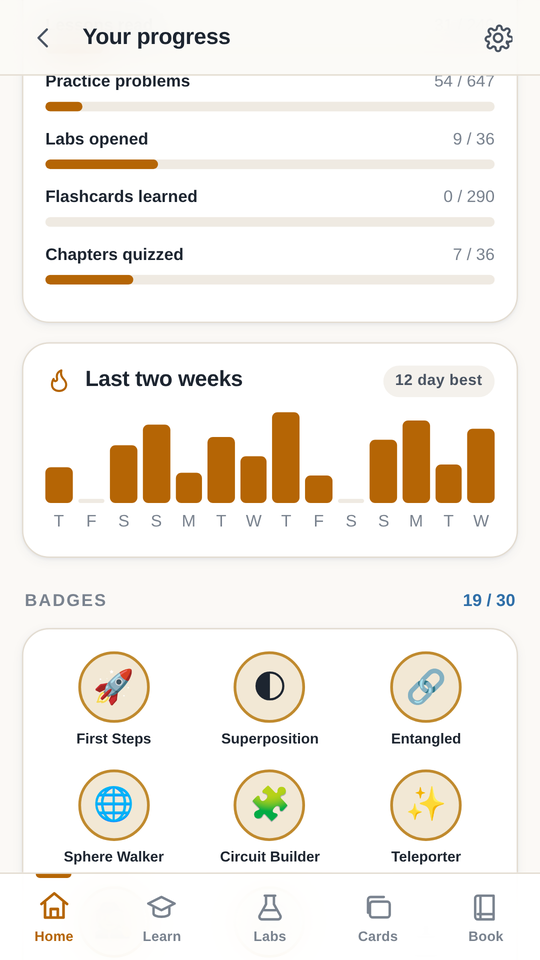
The app's home screen, showing level, streak and the chapter to continue The Bloch Explorer lab with a draggable sphere and live probabilities The circuit builder with a gate palette and a two-qubit circuit Grover's search lab showing signed amplitude bars The BB84 quantum key lab showing the sifted-key error rate A chapter lesson with equations and a figure A quiz question with an explanation of the right answer The progress screen with coverage, streaks and badges

A lab for every chapter

36 of them, one per chapter and appendix — state builder, measurement lab, circuit builder, teleportation, BB84, Grover, Shor, VQE, quantum machine learning, noise, error correction and hardware.

The whole book inside

All 393 pages are bundled in the app and read with a built-in page reader — bookmarks, night mode, and a jump straight to the chapter you are studying.

Quizzes that explain

360 questions written by hand, each one telling you why the right answer is right and linking back to the lesson that teaches it.

Flashcards that space themselves

290 cards covering every key term and equation, scheduled so a card returns just before you would have forgotten it.

Progress worth keeping

A guided path through the eight parts, with XP, daily streaks, 30 badges and a mastery reading for every chapter.

Private by construction

No permissions at all. No internet permission, so it cannot reach a network even if it wanted to. No ads, no analytics, no accounts. Your progress never leaves the device.

36Labs
393Pages
647Problems
360Quiz questions
290Flashcards
0Permissions
Install it

The app is in closed testing

It is on Google Play, but only people on the tester list can install it while testing runs. Adding yourself takes about ten seconds.

Step one — join the tester list Give the email of the Google account on your Android phone. That is the only thing needed.
Sign up to test
Step two — install from Google Play Once you are on the list you will get a link, and the app installs like any other.
Open on Google Play
Why the Play link may not work yet. Until you are on the tester list, that page will show as unavailable — this is how Google Play handles closed tests, not an error. Sign up first, wait for the invitation, then the same link will work. Requires Android 7.0 or newer.
The book

From classical bits to quantum machine learning

Thirty-one chapters in eight parts, and five appendices that teach the mathematics from nothing. Every chapter follows the same shape: learning goals, plain explanations with figures, key terms, real equations with worked examples, activities, a case study from the real world, common mistakes, a summary, and practice at three levels.

Part One
From Bits to the Quantum IdeaChapters 1–2
Part Two
The QubitChapters 3–5
Part Three
Gates and MeasurementChapters 6–8
Part Four
Many Qubits and EntanglementChapters 9–12
Part Five
Protocols, Programming, CryptographyChapters 13–16
Part Six
Quantum AlgorithmsChapters 17–21
Part Seven
Quantum AI and Machine LearningChapters 22–27
Part Eight
Real Machines, Real Limits, Real ProjectsChapters 28–31
Appendices
The Mathematics You NeedA–E, taught from zero
Every chapter
Part One — From Bits to the Quantum Idea
1Bits and Classical ComputingInformation, binary, and logic
2Why Quantum Computing Is DifferentAn honest map of what it can do
Part Two — The Qubit
3Qubits and Quantum StatesDirac notation and amplitudes
4Superposition and MeasurementThe Born rule, collapse, shots
5The Bloch SphereOne globe for every qubit state
Part Three — Gates and Measurement
6Single-Qubit Gates I: X, Z and HThe first three machines
7Single-Qubit Gates II: Y, S, T and RotationsFine control of the sphere
8Observables and Expectation ValuesTurning histograms into numbers
Part Four — Many Qubits and Entanglement
9Multi-Qubit Systems and Tensor ProductsTwo qubits, four amplitudes
10Controlled GatesCNOT, CZ, SWAP and Toffoli
11Entanglement and Bell StatesSpooky correlations, tested
12Quantum Circuits and Circuit DesignReading, simplifying, designing
Part Five — Protocols, Programming, and Cryptography
13Teleportation and Superdense CodingMoving states with classical bits
14Programming Quantum ComputersPython, NumPy and Qiskit
15Quantum Cryptography and CommunicationBB84 and catching an eavesdropper
16The Quantum InternetRepeaters, distillation, satellites
Part Six — Quantum Algorithms
17Deutsch–Jozsa and Bernstein–VaziraniThe first quantum victories
18Grover's Search AlgorithmFinding the needle by interference
19The QFT, Phase Estimation and ShorThe algorithm that started it all
20Variational Algorithms and OptimizationVQE, QAOA and hybrid methods
21Quantum SimulationWhy Feynman wanted this machine
Part Seven — Quantum AI and Machine Learning
22Encoding Data into Quantum StatesBasis, angle and amplitude encoding
23Variational Quantum ClassifiersA circuit that learns
24Quantum KernelsSimilarity as an inner product
25Quantum Neural Networks and TrainingGradients and barren plateaus
26Generative Models and Quantum AdvantageBorn machines and an honest map
27Quantum AI in PracticeHow to audit a quantum ML claim
Part Eight — Real Machines, Real Limits, Real Projects
28Noise, Decoherence and ErrorsWhy qubits fail, and the budget
29Quantum Error CorrectionProtecting qubits without looking
30Quantum Hardware and Our RegionFive ways to build a qubit
31Capstone ProjectsTwelve complete projects
Appendices — taught from zero
AComplex NumbersWhere quantum phases live
BVectors and MatricesThe matrices quantum mechanics needs
CThe Probability You NeedChance, spread and the square-root law
DFormula Sheet and Gate ReferenceEvery formula on six pages
EPython and NumPy Quick StartFrom zero to simulating qubits
Downloads

Free for anyone who wants to learn

The book is free to download and free to use in teaching. If you use it in a course, I would be glad to hear about it.

Student Edition 393 pages · 31 chapters · 5 appendices · 647 practice problems
Download PDF
Teacher's Guide — on request Teaching notes, self-tests with answers, and complete step-by-step solutions to all 647 problems. Sent to teachers and lecturers by email, so the solutions stay on your side of the desk.
Request by email
Using this in a course? The Student Edition is bundled inside the app, so students who install it already have the book offline. The Teacher's Guide is not published here or in the app — write to me from your institutional address and I will send it to you.